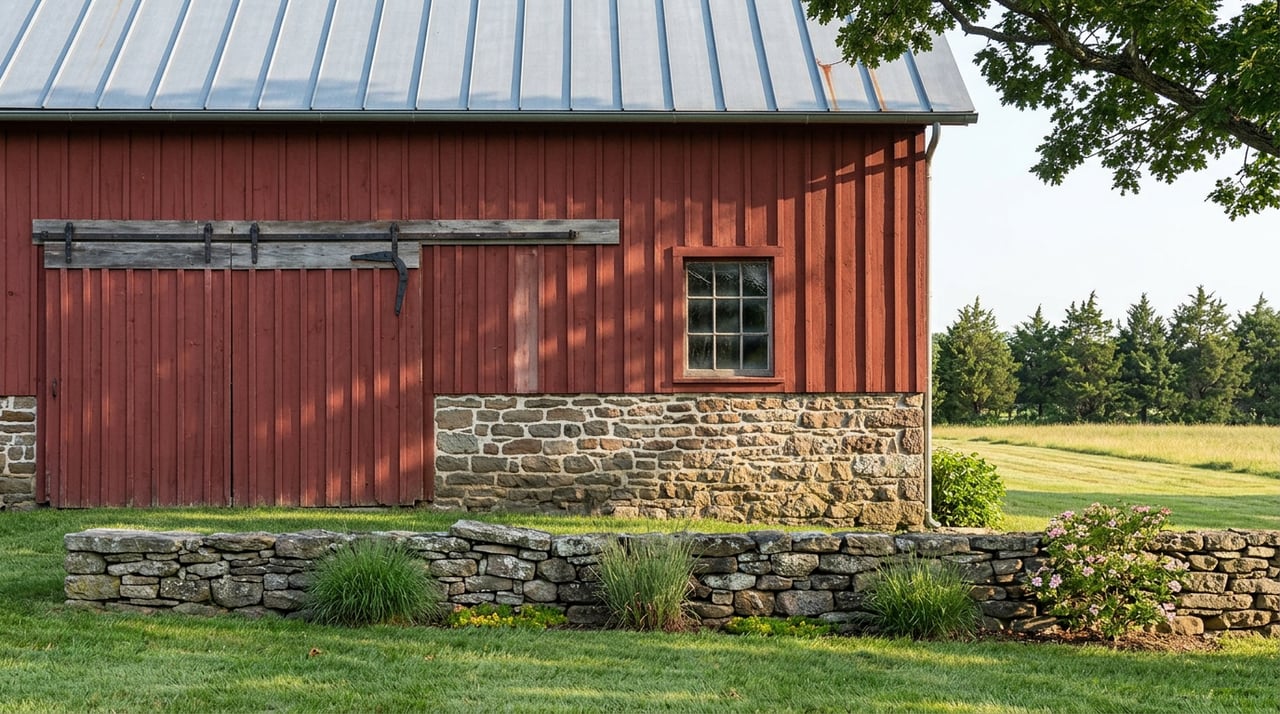
The listing read like every other Hunt Country dream: rolling acreage, mountain views, a gravel lane winding past hardwoods toward a building site that seemed to promise a house, a barn, maybe a guest cottage down by the pond. The buyer had already sketched a floor plan. Then the easement document came back from the county courthouse, and the plan collapsed into a half-acre corner of the parcel. One house. One location. Everything else on those hundred acres stays exactly as it is, permanently.
Design-build firms working across Fauquier County see this exact scenario often enough that they warn clients about it before design work even starts, and the seller in these cases usually isn't hiding anything. Nobody read the easement closely enough to know.
That's the friction most Delaplane land searches never surface, because the number everyone quotes, the median price or the price per acre, describes what a parcel costs. It says nothing about what you're actually allowed to do with it. In Delaplane, that second question is answered by a document, not by zoning, and roughly a quarter of the surrounding county's rural land is now governed by exactly that kind of document.
The Number That Overrides the Zoning Map
Fauquier County, where Delaplane sits, zones its rural land far more conservatively than its Loudoun County neighbor to the north.
| Jurisdiction | Rural Zoning Category | Minimum Parcel Size |
|---|---|---|
| Fauquier County | RA (Rural Agricultural) | 25 acres |
| Fauquier County | RC (Rural Conservation) | 50 acres |
| Loudoun County | AR-1 | 3 acres |
| Loudoun County | AR-2 | 5 acres |
Those minimums alone would make Fauquier a different kind of buying decision than Loudoun. But zoning is only the starting rule. A 2026 guide to Fauquier's rural building environment puts the deciding fact plainly: roughly 25% of the county's rural acreage now sits under a conservation easement, and when a parcel carries one, the easement overrides the zoning entirely. A 200-acre RA parcel that zoning alone would allow to be built out generously can be reduced by its recorded easement to a single home inside a three-acre building envelope, regardless of what the zoning map implies.
That override is the mechanism a Delaplane buyer needs to internalize before comparing two parcels that look identical on paper. Same zoning category, same acreage, same county. Wildly different buildable rights, because one of them has a private legal agreement layered on top that the other doesn't.
Whose Signature Is Actually on the Title
The organizations holding these agreements in and around Delaplane aren't obscure. The Virginia Outdoors Foundation holds the largest share of easements in Fauquier County, working alongside the Piedmont Environmental Council and the Land Trust of Virginia, a Middleburg-based nonprofit that has protected land across the region since 1992.
An easement doesn't mean a landowner stops owning or using the property. Under Virginia's framework, landowners continue to own, use and control their land, and can sell it or pass it on to heirs, and the agreement doesn't require the owner to grant public access. Rural uses like farming, forest management, hunting and fishing remain encouraged, not restricted. What changes permanently is the right to subdivide and build beyond whatever the recorded document allows, and that document runs with the land to every future owner. It doesn't expire when the current seller signs a deed.
What the Restriction Actually Bought a Neighboring Farm
The clearest illustration of what an easement changes isn't hypothetical. When the Land Trust of Virginia worked with the owner of Atoka Farm, a 350-acre property that zoning would have allowed to be split into roughly 20 house lots, the family agreed instead to retain rights to just three divisions. Sally Price, the trust's executive director, summed up the trade this way:
"We were happy to accommodate and take his easement donation because it eliminated 17 homes."
That's not an abstract conservation talking point. It's a direct answer to the question every Delaplane buyer should be asking about any large parcel: how many of the divisions the zoning technically permits does this specific easement actually retain?
The mechanism is still active today, not a relic of an older wave of donations. As recently as December 2025, the Land Trust of Virginia recorded a new 51-acre easement on the Finan Property southwest of Warrenton, permanently restricting future subdivision and development on land that's roughly two-thirds hay production today. It was the trust's 279th easement to date. Fauquier's supply of unrestricted, freely buildable acreage keeps shrinking in real time, one recorded document at a time.
Reading Delaplane's Price Spread Correctly
Current listing data for Delaplane, as of August 2026, shows a price-per-acre spread wide enough that it should stop any buyer from treating "price per acre" as a single, comparable number:
| Property Type | Average Price Per Acre |
|---|---|
| Undeveloped land | roughly $17,600 |
| Houses with land | roughly $50,000 |
| Farmland | roughly $55,000 |
Soil quality, road frontage, and existing improvements explain part of that gap. But building rights explain more of it than most buyers assume. A parcel where the buildable envelope is locked to a single acre in one corner is priced, and negotiated, differently than one where the buyer can still place a house, a barn, and a riding ring wherever the land suggests. One current Delaplane listing makes this explicit rather than burying it: a 378-acre parcel off Kilkenny Road marketed as protected under a Virginia Outdoors Foundation easement, with the complete easement document posted for buyers to review before they ever schedule a showing. That's the standard every serious offer on Delaplane acreage should be held to, whether the listing volunteers the document or not.
Before You Write an Offer
- Request the recorded easement from the Fauquier County Circuit Court Records Room at the county courthouse in Warrenton, not just a summary from the listing agent.
- Locate the building envelope described in the document and confirm its acreage and exact position on the parcel, not just its existence.
- Identify how many subdivisions the easement retains, if any, separate from what the underlying RA or RC zoning would otherwise allow.
- Confirm which organization holds the easement, VOF, PEC, the Land Trust of Virginia, or Fauquier County directly, since each conducts its own annual monitoring visit and enforcement.
- Bring in an attorney or appraiser with specific easement experience before you finalize a number, since the restriction affects both what you can build and what the property will appraise for later.
A Few Questions That Come Up Every Time
Does a conservation easement automatically lower what I should offer? Not automatically. It depends entirely on whether the building envelope and retained subdivision rights match what you actually intend to do with the land. A buyer who wants one house and open pasture may find an eased parcel priced fairly for exactly that use.
Can I still build a barn or add a riding ring under an easement? Often, yes. Easements are drafted to allow farm buildings and other structures typical of rural land, but the specifics vary by document, which is exactly why reading the recorded easement, not a summary, matters before you commit.
Does the easement go away if the property is sold again later? No. It's designed to be permanent, and it binds every future owner exactly as it bound the one who signed it.
Delaplane's land market rewards buyers who read the fine print before they fall for the view. If you're evaluating acreage here, whether it carries an easement or not, Kristin Dillon-Johnson can walk the recorded documents with you before you write an offer. Schedule a free consultation and know exactly what you're buying, corner to corner.