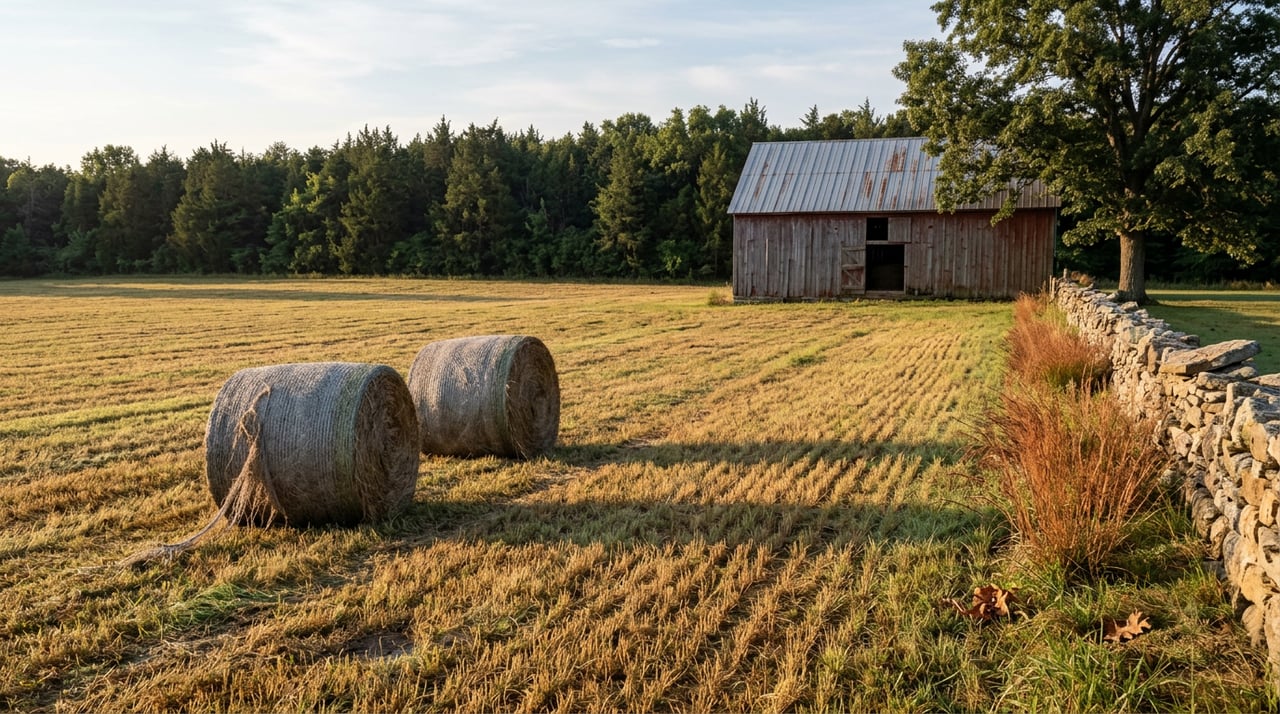
Two farms sit within a few miles of each other outside Marshall, both around twenty-some acres, both with a barn and a run-in shed, both priced to reflect what buyers are paying for equestrian ground in northern Fauquier County right now. On paper they look like close comparables. Once you own either one, they can behave like two completely different assets, and the difference has nothing to do with soil, water, or how many stalls the barn has.
It comes down to a line item most buyers never ask about until closing: whether the land is enrolled in Virginia's land-use assessment program, and what the buyer plans to do with it afterward.
Two Farms, Same Road, Different Math
Fauquier County, like most of Virginia, lets qualifying agricultural, horticultural, forest, and open-space land get taxed on what it earns rather than what it could sell for. A parcel actively used for hay, cattle, or horses at the required stocking level gets assessed at use value. A parcel that isn't farmed, or that's too small to qualify, gets assessed at full market value, the number a developer or a buyer with no farming plans would actually pay.
The acreage minimums matter here. Agricultural and horticultural land needs at least five qualifying acres. Forest land needs twenty. Open space needs twenty-five, and generally has to sit inside an approved agricultural and forestal district or under a recorded conservation easement to count. A seven- or eight-acre parcel with a house on it, common in the Marshall area, often can't clear the bar at all once the homesite and curtilage are carved out.
That single fact explains a pattern in the current listings that otherwise looks strange. Horse properties around Marshall are averaging roughly $16,000 per acre right now, while smaller hobby farms in the same general area are trading closer to $69,000 per acre. It isn't that the smaller parcels have better dirt. It's that they're too small to qualify for use-value taxation, so the price reflects full market value and development potential rather than farm income, while the larger enrolled tracts are priced against their working, taxed-as-a-farm reality.
One current example in the broader Fauquier farm market, a nearly 190-acre tract listed through Thomas & Talbot Estate Properties, is marketed explicitly around its suitability for farming and recreation. That framing isn't just marketing language. It signals to a buyer that the tract has been carrying its tax bill as working agricultural land, and that whoever buys it will inherit a decision about whether to keep it that way.
What Actually Flips the Switch
Here's the part that trips up buyers who assume a closing wipes the slate clean. The sale of an enrolled farm does not, by itself, trigger a rollback assessment. Fauquier's land-use rules track use, not ownership. If the new owner keeps the land in a qualifying agricultural, horticultural, forest, or open-space use and files the required revalidation, the classification carries forward without penalty.
What does trigger it is a change in how the land is used. Fauquier's own guidance lists the common ones: converting the land to a non-qualifying use, rezoning to something more intensive, or splitting off a lot in a way that breaks the qualifying acreage. Practically speaking, that covers a lot of what a new owner might actually want to do with a Marshall farm. Adding a second dwelling for a family member on what had been open pasture. Carving off a few acres for a child's homesite. Letting hayfields go unmanaged because the horses moved elsewhere. Any of these can convert a farm from a use-value asset back into a market-value one, and the county doesn't wait for the next reassessment cycle to collect the difference.
The Six-Year Look-Back
When a rollback is triggered, Fauquier calculates the gap between what was actually paid at use value and what would have been owed at fair market value, for the current tax year plus the five immediately preceding years. On top of that difference, the county adds ten percent simple interest for each year the tax was deferred. Six years of deferred taxes plus interest on a farm that's been enrolled for a decade or more is not a rounding error. On a mid-size Marshall property, it can run into the tens of thousands of dollars, assessed against whoever owns the land at the moment the qualifying use ends, not necessarily the person who originally enrolled it.
Unpaid rollback becomes a real lien against the property, which is exactly why it belongs in a buyer's due diligence rather than an afterthought after closing. Fauquier completed its most recent countywide reassessment effective January 1, 2026, and the next one won't happen until January 1, 2028. That two-year window matters because the fair-market side of any future rollback calculation gets locked to whatever the county's assessors set during that cycle, not to whatever the open market does in the meantime.
Before You Write an Offer
A few questions, asked early, save a lot of surprise later:
- Ask the seller's agent or the seller directly whether the parcel is currently enrolled in the land-use program, and under which classification: agricultural, horticultural, forest, or open space.
- Request a written status confirmation from the Fauquier County Commissioner of the Revenue, including the parcel's PIN, current classification, and last revalidation date.
- Ask whether any rollback has already been assessed or is pending, and instruct your title company to search specifically for land-use liens, not just standard judgment and mechanic's liens.
- If your plans include a second dwelling, a subdivided lot for family, or anything beyond continuing the existing farm or forestry use, get the county's written view on what that does to the enrollment before you're under contract, not after.
- If you intend to keep the land in production, confirm what annual revalidation requires so you don't lose the classification through paperwork rather than through an actual change in use.
None of this shows up on a listing sheet, and none of it shows up in the per-acre price comparison a buyer runs across a handful of Marshall properties. It shows up in the closing file, or worse, in a tax bill that arrives after closing with six years attached to it.
A Few Questions That Come Up Often
Does buying an enrolled farm mean I automatically inherit a future tax bill? Not automatically. You inherit the classification and the obligation to keep using the land in a qualifying way. The rollback only activates if the use changes, not simply because ownership changed hands.
Can I keep the land-use classification if I only farm part of the property? Often yes, provided the actively used portion still meets the acreage and production standards for its category. The unqualified portion, including the home's curtilage, is typically assessed separately at market value regardless.
What if I want to build a barn, run-in shed, or arena rather than a house? Agricultural structures generally support rather than threaten the qualifying use. It's residential construction, subdivision, or a shift away from active production that tends to draw scrutiny from the Commissioner's office.
Marshall's farms and equestrian properties reward buyers who understand what they're actually pricing. A low per-acre number on a working farm isn't a bargain by accident. It's a number built on a tax structure that only holds if the next owner keeps the land doing what the last owner was doing with it.
If you're weighing a Marshall-area farm or acreage property and want to understand what its current land-use status actually means for your plans, Kristin Dillon-Johnson can walk through the specifics with you before you write an offer. Schedule a free consultation to get a clear read on what a property's tax history is really telling you.