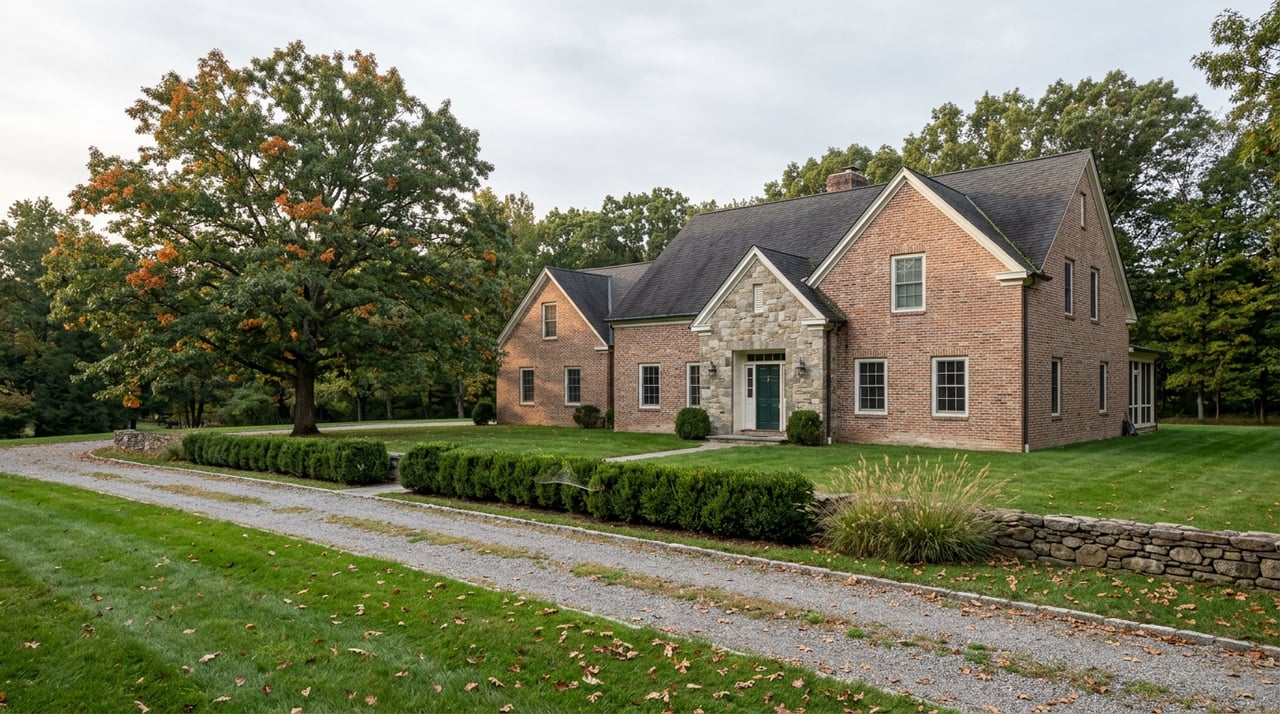
A single line on a property tax bill can double for two houses that look almost identical, sit less than a mile apart, and both call themselves Bluemont. That is not a data error. Bluemont's postal boundary, 20135, crosses Loudoun County, Clarke County, and Jefferson County, West Virginia, and the county line that runs through the village does more to shape your ownership costs than the size of your lot or the age of your house. Before you compare a Bluemont listing to anything else in Hunt Country, it helps to know which Bluemont you are actually looking at, because there are at least three of them sharing one name.
The village core is smaller than most buyers assume
When people picture Bluemont, they usually picture the cluster of stone and frame buildings along Snickersville Turnpike, the road that has carried the village's traffic since it was known as Snickersville in the early 1800s. That picture is accurate, but the protected core is tighter than it looks from a drive-through. The Bluemont Historic District, listed on the National Register in 1984, contains just 43 buildings: 36 houses, five commercial structures, a church, and a community center. The oldest is Clayton Hall, a stone house built in 1797 by the village's founding family.
For properties inside that boundary, Loudoun County requires review and approval from its Historic District Review Committee for most exterior changes, from a new porch to a replacement roofline, before work can begin. That is not a formality you can skip because you own the building. It is a design review with real authority over what the street looks like, and it adds a step to any renovation timeline that a buyer outside the district never has to plan for.
Step a few hundred yards past those 43 buildings, though, and you are outside the historic district. Most of what gets marketed as Bluemont real estate is not inside it at all.
The tax bill changes before the school bus does
Once you're outside the small historic core, the next thing that determines your ownership costs is which county you landed in, and that split runs straight through the community. Bluemont sits on the border between Loudoun and Clarke counties, and depending on which side of Blue Ridge Mountain Road a parcel falls, a homeowner can end up paying close to double the property tax that a near-identical house pays on the other side. Two buyers can compare listing photos that look interchangeable and walk into very different annual carrying costs simply because of where the county line happened to fall a century ago.
This is worth confirming before you get attached to a specific house, not after. The parcel's county of record determines which building department issues your permits, which office handles your tax assessment, and in the case of the historic core, whether the Historic District Review Committee has any say in your project at all.
Outside the village, well and septic are the infrastructure, not the exception
Move further out and a different pattern takes over. Communities like Shenandoah Retreat, a mountain subdivision mostly in Clarke County near the Shenandoah River, represent a large share of what actually trades hands under the Bluemont name. These lots typically sit along private roads and depend entirely on individual wells and septic systems because there is no public water or sewer service reaching this part of the mountain.
That changes what due diligence actually looks like. Recent listing language in this pocket of the market includes phrases like "buyer to verify all utilities and property use restrictions" and "the seller has not conducted any soil studies, surveys, or inspections." Skipping that verification on a Bluemont mountain lot is a different risk than skipping it on a public-utility lot in town, because there is no fallback system to catch the gap.
The largest parcels sit at the other end of the spectrum
At the other end of the spectrum sit the larger holdings, land near the Piedmont Hunt Territory and estates like Boxley Farms, where lot sizes run into double digits of acreage and prices climb well past two million dollars.
Why the published numbers don't agree with each other
This three-part structure explains something that trips up buyers doing early research online: the automated home-value estimates for Bluemont don't match each other. One widely used tracker put the village's average home value at $653,102 as of late July 2026, up 3.4 percent over the prior year. Around the same time, another portal's estimate of the median single-family price landed closer to $780,000, while noting that simple cabins in the area can sell in the low $300,000s and the highest-end estates can clear $2 million.
Neither number is wrong. They're sampling different rooms of the same house. A month with more mountain cabins and starter homes changing hands pulls the average down. A month with more historic-core sales or Hunt Country estate closings pulls it up. In a village this small, with reportedly around a third of homes carrying a barn suited to horses or alpacas, the mix of what happened to sell in any given 30-day window can swing the headline number more than the underlying market actually moved. Treat any single Bluemont price point as a snapshot of whichever product happened to trade that month, not as a read on the whole village.
What this settles before you write an offer
Before comparing a Bluemont property to anything else in Loudoun or Clarke County, three questions are worth answering directly:
| Question | Why it matters |
|---|---|
| Is the parcel inside the 43-building historic district? | Shows whether the parcel falls inside the district boundary |
| Which county holds the deed? | Sets the property tax rate and which building department issues permits |
| Does the parcel rely on private infrastructure? | Wells, septic systems, and private roads are the norm outside the village core, and their condition needs independent verification rather than assumption |
None of these questions show up in a portal's price estimate. All three show up in the closing documents.
FAQ
Is every home in Bluemont subject to historic district review? No. Most Bluemont-area properties sit outside the historic-district boundary along Snickersville Turnpike.
Does the historic district review interior renovations too? Confirm the specific scope for your property directly with Loudoun County before assuming interior work is exempt.
Do all Bluemont properties use well and septic? Not the ones inside the small historic village core, but a large share of the surrounding subdivisions and acreage do, since public water and sewer don't extend across most of this part of the mountain.
Why does the county line matter if the village feels like one community? The county line determines your tax rate and which local government issues permits and enforces zoning. Two houses can share a driveway view and still answer to different courthouses.
If you're comparing a Bluemont listing against something in Round Hill, Purcellville, or further into Hunt Country, the address alone won't tell you which of these three Bluemonts you're standing in. Kristin Dillon-Johnson has spent her career inside these distinctions, from the historic core to the mountain subdivisions to the easement-protected acreage further out, and can walk through exactly what a specific parcel's county, utilities, and easement status mean for your plans. Schedule a free consultation before you write an offer, not after the survey comes back with a surprise.
This article is general information, not legal, tax or financial advice. Consult a qualified professional about your situation.